
The Last Drop

The REMAP CAP Ivermectin for COVID-19 Trial

The Science of Stopping

 |  Rob Mac Sweeney

Junius Brutus Stearns, Washington on his Deathbed, 1851. Oil on canvas. Wikimedia. Public domain.

Figure 1: Junius Brutus Stearns, Washington on his Deathbed, 1851. Oil on canvas  | Wikimedia.

On the morning of December 14th, 1799, George Washington was not abandoned by medicine. He was surrounded by it. His physicians bled him repeatedly, administered emetics, enemas and blistering agents, and pursued the most active therapeutics that elite eighteenth-century medicine could offer. By evening he was dead, after probable acute bacterial epiglottitis and after losing a catastrophic volume of blood. The tragedy is not that his doctors did nothing. The tragedy is that they did far too much, with confidence unrestrained by evidence.1,2

Bloodletting survived for millennia because it made sense within the dominant theory of disease. It was plausible, visible, authoritative and dramatic. It offered a grammar of action: illness was excess, imbalance, congestion; the physician restored order by opening a vein. Only when clinicians such as Pierre-Charles-Alexandre Louis began counting outcomes, comparing like with like, and asking whether bled patients actually did better did the old therapy begin to lose its scientific credibility.3,4

REMAP-CAP’s ivermectin trial belongs in this historical lineage. The comparison with bloodletting is not one of direct toxicity or barbarism; ivermectin, at the pragmatic dose used in REMAP-CAP, was not associated with serious adverse events. The parallel instead lies in something more enduring and more dangerous: the tendency of medicine, particularly during crisis, to confuse plausibility, confidence and interventional activity with evidence that patients actually benefit. The epistemic pattern is familiar: a biologically thin rationale, public confidence far beyond the data, influential voices promoting therapeutic certainty, and clinical use spreading before the evidence had matured. REMAP-CAP is therefore not only a trial of ivermectin. It is a modern trial of stopping.5,6

This matters because COVID-19 was not an abstract scientific inconvenience. It caused more than seven million reported deaths worldwide, while clinicians were forced to make decisions under fear, uncertainty, public scrutiny and therapeutic scarcity.7 Some treatments were implemented because randomised trials showed benefit. Others entered practice because they were inexpensive, available, plausible, emotionally attractive, or amplified by public figures whose confidence exceeded existing data. Ivermectin became the archetype of the second phenomenon.

The central lesson of this trial is therefore not simply that ivermectin was unlikely to help hospitalised patients with COVID-19. The deeper lesson is that de-implementation of a non-beneficial therapy can be as important as implementation of a beneficial one. Medicine does not progress only when it discovers a new treatment. Sometimes it progresses when it develops the discipline to put down the lancet.


Bloodletting and the seduction of doing something

Bloodletting was not a marginal practice. It was among the central rituals of pre-modern therapeutics. It crossed cultures and centuries. It was practised by physicians, surgeons and barber-surgeons. It reached its European peak in the nineteenth century, precisely at the moment when medicine was becoming more professional, not less.3 Its persistence is therefore not best explained by stupidity. It is better explained by the seductive power of a coherent but wrong model.

To the physician steeped in humoral theory, bloodletting was not irrational. Fever, inflammation, congestion and agitation all seemed to demand evacuation. The treatment was active, personalised and visible. The patient felt something. The family saw something. The physician did something. In the emotional economy of illness, that matters.

This is one reason ineffective therapies can be so hard to remove. They often satisfy needs that evidence-based medicine is bad at acknowledging: the need for agency, the need for hope, the need for a visible intervention when the honest alternative is uncertainty. Bloodletting gave medicine a ritual of action. So, in a very different way, did many pandemic repurposed therapies.

The beginning of the end of bloodletting did not come from a more elegant theory. It came from counting. Pierre-Charles-Alexandre Louis applied his “numerical method” to conditions including pneumonia, comparing outcomes among patients who were bled early and those bled later. His work was imperfect by modern standards, but conceptually radical: therapeutic authority could be challenged by grouped patient outcomes.4

That is the historical echo in REMAP-CAP. The question was not whether ivermectin had a story. It had several. The question was whether patients receiving ivermectin did better than patients who did not. The transition from story to comparison is one of the most important advances in medicine.


The confidence was never proportionate to the evidence

Ivermectin is not a fringe molecule. It is a widely used antiparasitic medicine, included on the World Health Organization Model List of Essential Medicines, with decades of experience in appropriate indications.6 That familiarity mattered. A cheap, orally available, globally accessible drug with an established safety profile is precisely the sort of intervention one would wish to work in a pandemic. If ivermectin had been effective against COVID-19, its implications for global health would have been enormous.

But wishfulness is not pharmacology. The certainty with which ivermectin was promoted was never proportionate to the quality of the evidence supporting it. The REMAP-CAP supplementary appendix is unusually explicit on this point. It describes ivermectin being promoted as a “miracle cure”, used outside trials in high-, middle- and low-income countries, advanced through advocacy groups and clinical guidance, discussed in political hearings, and associated with public narratives of dramatic recovery. It also describes lobbying, formulary pressure and even smuggling in some regions because of public demand.6

This was not a quiet drug-repurposing hypothesis awaiting evaluation. It was a social movement attached to a pharmacological claim. That distinction matters. A weak treatment hypothesis can be safely ignored when it remains marginal. Once it enters routine care, it becomes a health-system problem.

The prescribing signal was real. In the United States, outpatient ivermectin dispensing increased substantially during the pandemic, with one analysis reporting a rise from a pre-pandemic average of approximately 3,600 prescriptions per week to a peak of approximately 39,000 prescriptions in the week ending January 8, 2021.8 The CDC later warned of increased ivermectin dispensing, use of veterinary formulations, and a rise in poison control centre calls related to ivermectin exposure.9 A later national survey associated use of ivermectin or hydroxychloroquine for COVID-19 with endorsement of misinformation, lower trust in physicians or scientists, conspiracy-mindedness, and news-source patterns.10

That is the context in which REMAP-CAP should be read. The trial was not merely testing a drug. It was testing whether medicine could recover the authority of evidence after public conviction had already run ahead of it. Bloodletting had its humoral cosmology; ivermectin had its online ecosystem. In both cases, the therapy became socially useful before it was clinically proven.
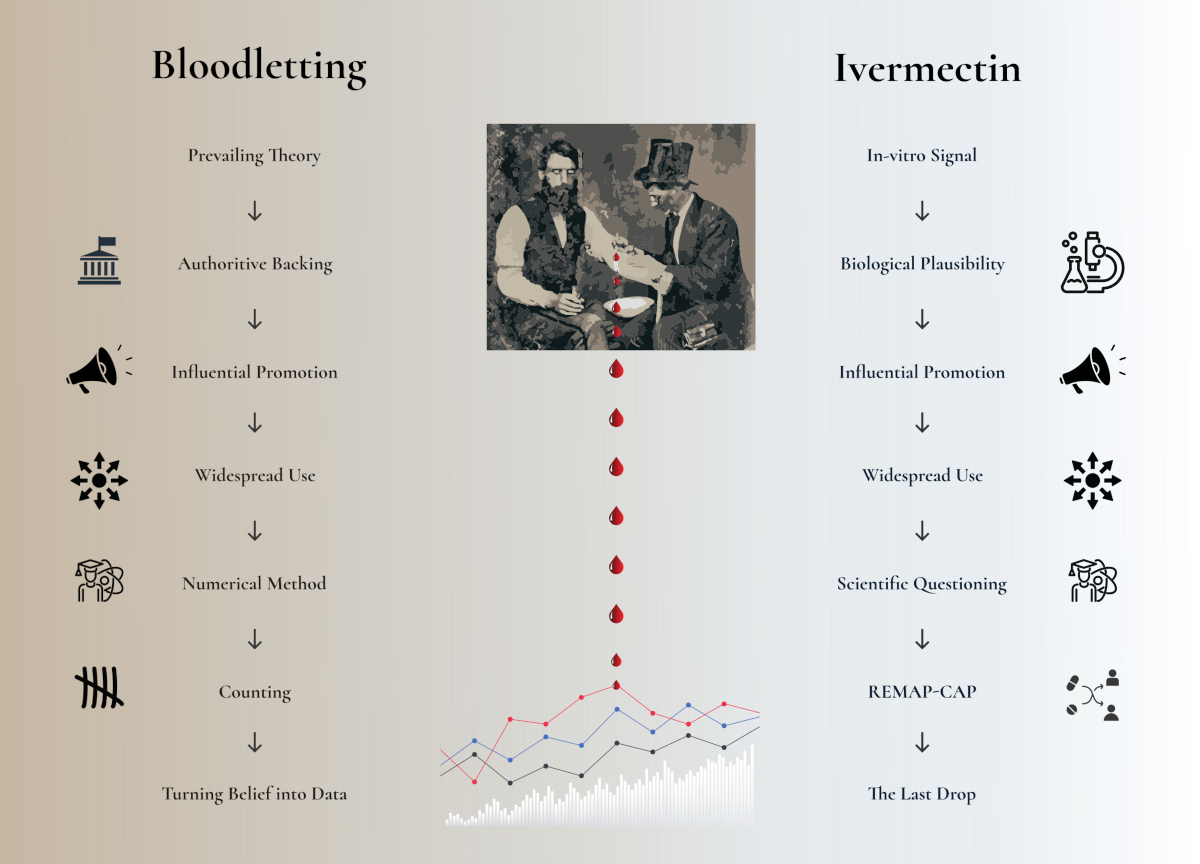
Reasoning for the popularity of ivermectin, as contrasted with bloodletting

Figure 2. How Bloodletting and Ivermectin for COVID-19 were Adopted and De-Adopted

The pharmacology was never the prophecy

The ivermectin story began, as many repurposing stories do, with a signal in the laboratory. Caly and colleagues reported that ivermectin inhibited SARS-CoV-2 replication in vitro, a finding that attracted immediate attention because the drug was already licensed for other uses and widely available.11 There were also proposed anti-inflammatory effects and animal-model observations, which created a surface-level plausibility for both antiviral and host-response mechanisms.6

Yet the leap from cell culture to patient was always large. The key pharmacological problem was concentration. Schmith and colleagues argued early in the pandemic that the approved dose of ivermectin alone was unlikely to achieve the exposures required for the proposed antiviral effect, making successful clinical translation improbable at standard dosing.12 The REMAP-CAP supplementary appendix reaches a similar conclusion: there were multiple proposed mechanisms, but no single mechanism was highly likely to confer therapeutic effect, and some of the concentrations required were not easily achievable in clinical practice.6

Even Merck, the manufacturer of ivermectin, issued a public statement in February 2021 saying its review had identified no scientific basis for a potential therapeutic effect against COVID-19 from preclinical studies, no meaningful evidence of clinical activity or efficacy, and a concerning lack of safety data in most studies.13 The FDA has also stated that ivermectin has not been authorised or approved for preventing or treating COVID-19 and that available clinical trial data do not demonstrate effectiveness against COVID-19 in humans.14

This does not mean ivermectin was irrational to test. It means it was irrational to believe strongly before testing. Plausibility is a reason to do a trial. It is not a substitute for one. Bloodletting had a mechanism too. The problem was that its mechanism belonged to a theory of disease that patients kept failing to survive.


Why a weak hypothesis still needed a strong trial

There is a temptation to say that ivermectin should simply have been ignored. The preclinical rationale was weak, the pharmacology problematic, and the early clinical evidence unreliable. But that argument fails once a therapy is already being used. When a treatment enters practice before evidence, the evidence question changes. It is no longer only, “Could this work?” It becomes, “How do we stop using it if it does not?”

This is where REMAP-CAP becomes ethically important. The investigators explicitly state in the supplementary appendix that enthusiasm for ivermectin was not supported by the preclinical rationale or available clinical evidence, but that widespread clinical use in the absence of evidence created an imperative for high-quality randomised trials.6 That sentence is the moral centre of this research.

A therapy with a low prior probability of benefit may still require rigorous evaluation if it has escaped into clinical practice. Without randomised evidence, clinicians are left with anecdotes, motivated reasoning, and arguments from authority. With randomised evidence, de-implementation becomes possible. A trial is not a failure if it removes a non-beneficial treatment from the bedside.

By 2022, the outpatient evidence was already moving against ivermectin. The Cochrane review found no evidence to support ivermectin for treating COVID-19 or preventing SARS-CoV-2 infection.15 López-Medina and colleagues found no significant improvement in time to symptom resolution among adults with mild COVID-19 treated with ivermectin.16 The TOGETHER trial found that early treatment with ivermectin did not reduce medical admission to hospital or prolonged emergency department observation among outpatients with COVID-19.17 COVID-OUT, I-TECH, and ACTIV-6 also failed to produce convincing clinical benefit, including at higher dose and longer duration in ACTIV-6.18,19,20,21

The WHO living guideline is now correspondingly cautious, with recommendations against ivermectin use in COVID-19 outside appropriate trial contexts.22 But REMAP-CAP addressed a remaining question. What about patients admitted to hospital? What about the critically ill? What about the settings where cheap, available therapies had particular appeal because expensive biologics and newer antivirals were less accessible? This was not a redundant question. It was the question that remained clinically and globally relevant.

The bloodletting analogy is useful here too. Bloodletting did not disappear because every possible patient, disease stage, dose of bleeding, and clinical context had been refuted. It disappeared because the general therapeutic claim became untenable. Medicine rarely closes every metaphysical door. It closes the doors that matter for practice.


What did REMAP-CAP do?

REMAP-CAP is not a conventional two-arm trial bolted onto usual care. It is an international, embedded, multifactorial, adaptive platform trial designed to learn across multiple therapeutic domains in patients with severe pneumonia, including pandemic respiratory infection.23 Its design is important because it allows patients to be randomised across multiple domains, uses Bayesian modelling, and can adapt randomisation probabilities as evidence accumulates.23

In the ivermectin domain, hospitalised adults with suspected or confirmed COVID-19 were enrolled in Pakistan, India, and Ireland between June 11, 2021, and September 9, 2022. Patients were categorised as critically ill if they were receiving respiratory or cardiovascular organ support in an ICU; other hospitalised patients were categorised as noncritically ill.5

The intervention was pragmatic: enteral ivermectin 0.2 mg/kg once daily, to a maximum of 24 mg daily, for up to five days or until hospital discharge.5 The comparator was no ivermectin, with all other care provided according to site standard care.5

The primary outcome was organ support-free days, a composite ordinal outcome that assigns death the worst value and then, among survivors, counts days alive and free from respiratory or cardiovascular organ support through day 21.5 In plain language, it asks: was the patient alive, and if so, how quickly did they escape major organ support?

This is a particularly appropriate endpoint for critical care. Mortality alone is often too blunt. A patient who survives after prolonged ventilation, vasopressors, renal replacement therapy, and weeks in ICU has not experienced the same outcome as a patient who survives quickly and cleanly. Organ support-free days capture both survival and the burden of critical illness.

Louis counted pneumonia patients in nineteenth-century Paris to interrogate bloodletting. REMAP-CAP counted organ support-free days in twenty-first-century COVID-19 to interrogate ivermectin. The tools are different. The moral discipline is the same: do not ask whether the treatment feels plausible; ask whether patients do better.

Outcome Critically ill Noncritically ill
Patients analysed 61 89
Median organ support-free days −1 vs −1 22 vs 22
Adjusted OR (95% CrI) 0.94 (0.40–2.07) 1.04 (0.48–2.34)
Posterior probability of superiority 44.2% 53.7%
Hospital survival 35.1% ivermectin
37.5% control
84.1% ivermectin
77.8% control

CrI = credible interval. Data from the REMAP-CAP ivermectin trial.5

Table 1.Trial Outcomes

What did REMAP-CAP find?

The trial randomised 150 patients with analysable primary outcome data: 61 critically ill patients and 89 noncritically ill patients.5 Recruitment closed because of operational futility, following low recruitment after external multicentre trials in nonhospitalised patients suggested no benefit with ivermectin.5,6 This distinction matters: the trial did not stop because REMAP-CAP’s prespecified Bayesian statistical trigger for futility had been met. It stopped because the external evidence ecosystem had moved, recruitment had fallen, and continuing became operationally unrealistic.

The critically ill result is stark. Median organ support-free days were −1 in both groups, meaning death was the most common outcome. Hospital survival was 35.1% with ivermectin and 37.5% with control, with an adjusted odds ratio of 1.00 and a posterior probability of superiority of exactly 50.0%.5 In other words, the critical illness cohort provided no persuasive signal that ivermectin improved survival or recovery.

The noncritically ill result is superficially more tempting, because survival to hospital discharge was numerically higher with ivermectin: 84.1% versus 77.8%. But the adjusted estimate was imprecise, the credible interval was wide, and the posterior probability of superiority for hospital survival was only 63.3%.5 That is not a clinical signal on which to build practice. It is the sort of point estimate that invites overinterpretation if one forgets uncertainty.

Secondary outcomes did not rescue the hypothesis. Ivermectin did not improve time to ICU discharge or hospital discharge, did not improve 90-day survival, did not reduce progression to invasive mechanical ventilation, ECMO, or death, and did not improve WHO ordinal scale status at day 14.5 There were no serious adverse events reported in either group, which is reassuring for the pragmatic dosing strategy used, but safety without efficacy is not a reason for routine use.5

Bloodletting was also often defended because the physician could point to a patient who survived after being bled. Anecdote is emotionally powerful because recovery after treatment is easily mistaken for recovery because of treatment. REMAP-CAP resists that error. It asks not whether some patients recovered after ivermectin, but whether recovery was more likely with ivermectin than without it. That is the difference between therapeutic theatre and clinical science.


“Not superior, not futile” is not a contradiction

The most easily misunderstood sentence in the paper is that ivermectin was “not shown to be superior or futile”, but was unlikely to improve organ support-free days or hospital survival.5 To many readers, this sounds evasive. It is not. It is a Bayesian trial being honest.

REMAP-CAP prespecified a high threshold for declaring efficacy: more than 99% posterior probability of superiority. It also prespecified a futility threshold: more than 95% posterior probability that the odds ratio was less than 1.2, meaning a low probability of at least a 20% odds-ratio improvement.5,6 The trial crossed neither threshold. That does not mean the result is clinically neutral. It means the formal platform conclusion was not triggered before recruitment became operationally untenable.

The appropriate interpretation is therefore calibrated rather than theatrical. REMAP-CAP does not prove that every conceivable ivermectin regimen, dose, timing, variant era, or subgroup is incapable of benefit. It does show that, in the hospitalised critical and non-critical COVID-19 populations tested, with the regimen used, there was no persuasive evidence of clinically meaningful benefit. That is enough to make routine hospital use scientifically indefensible.

This is often how stopping works. Bloodletting did not vanish after one perfect experiment. It was progressively narrowed, challenged, counted, and finally stripped of its general authority. The same standard should apply here. One does not need omniscience to stop a treatment. One needs enough evidence to know that continuing it is no longer defensible.


The global health story matters

One of the most important strengths of the trial is also one of its interpretive challenges. Ninety-six percent of participants were randomised in Pakistan, with a further 3% in India.5 This was not a trial in which low- and middle-income settings merely consumed evidence generated elsewhere. It was a trial in which the question was tested largely in the settings where the drug was available, affordable, and of direct clinical interest.

That matters because COVID-19 therapeutics were never globally equitable. Expensive biologics and newer antivirals were often less accessible in many health systems, and global treatment divides were repeatedly highlighted during the pandemic.24 The attractiveness of ivermectin in such contexts was not irrational at the level of access. A cheap generic drug that worked would have been transformative. The problem was not the desire for an affordable therapy. The problem was promoting one before there was credible evidence that it helped.

The background therapy also reminds us that “standard care” is not a universal constant. In REMAP-CAP’s ivermectin cohort, 92% of patients received glucocorticoids and 78% received remdesivir at or within 48 hours of enrolment, while only 5% received tocilizumab or sarilumab, mainly because of cost or availability.5 Mortality was high: 64% in critically ill patients and 19% in noncritically ill patients.5 The trial therefore also speaks to the uneven geography of critical care: different pathways to hospital, different thresholds for organ support, different availability of proven immunomodulators, and different constraints on what “usual care” can mean.

This is why the bloodletting metaphor must be handled carefully. The issue is not that clinicians in resource-limited settings were uniquely vulnerable to bad evidence. The opposite is closer to the truth: they were confronting a global evidence failure while facing local therapeutic scarcity. A low-cost therapy deserved to be tested rigorously because, if it had worked, the benefits would have been greatest where resources were most constrained. REMAP-CAP’s achievement is that it did not outsource that question elsewhere.


Implementation and de-implementation are mirror images

The pandemic produced examples of both implementation and de-implementation. Dexamethasone moved rapidly into practice after RECOVERY demonstrated lower 28-day mortality among hospitalised patients receiving oxygen or invasive mechanical ventilation.25 Tocilizumab and sarilumab entered the therapeutic armamentarium for critically ill patients after REMAP-CAP showed improved outcomes with IL-6 receptor antagonists.26 Those were classic implementation stories: evidence arrived, and practice changed by adding something beneficial.

But the opposite is also true. REMAP-CAP previously showed that lopinavir-ritonavir, hydroxychloroquine, and their combination worsened outcomes in critically ill patients with COVID-19 compared with no antiviral therapy.27 That was not a lesser achievement because it removed rather than added treatment. The value of evidence is not measured by how many drugs survive the trial. It is measured by how many patients do and how they do so.

Ivermectin belongs to this second tradition. De-implementation is not therapeutic nihilism. It is not the absence of care. It is the deliberate removal of practices that have persisted through hope, habit, influence, fear, or institutional inertia rather than demonstrable benefit.

The history of bloodletting is the history of de-implementation before the word existed. The lancet had to be removed from the ordinary repertoire of medicine. Not because physicians became less caring, but because they became more accountable to outcomes. That is the same intellectual movement that illuminates how a "negative" trial is anything but negative and can contribute so much to patient care.

The low-value care literature makes this explicit. Low-value services can cause harm through direct adverse effects, psychological burden, opportunity cost, financial waste, and downstream cascades of further care.28 De-adoption of low-value clinical practices is now recognised as a major challenge for health systems, requiring active strategies rather than passive diffusion of evidence.29 Evidence-based de-implementation is particularly important when practices are contradicted by better evidence but sustained by culture, politics, or professional identity.30

This is why the ivermectin trial matters. The harm of a non-beneficial COVID-19 therapy is not limited to toxicity. It can also include substitution for effective care, delay in seeking appropriate treatment, confusion in clinician-patient conversations, erosion of trust, resource diversion, and the crowding out of better questions. In the United States, insurer spending on ivermectin prescriptions for COVID-19 was estimated to represent avoidable waste, illustrating that even inexpensive drugs can become costly when used at scale without benefit.31

Devil and Angel's Advocates

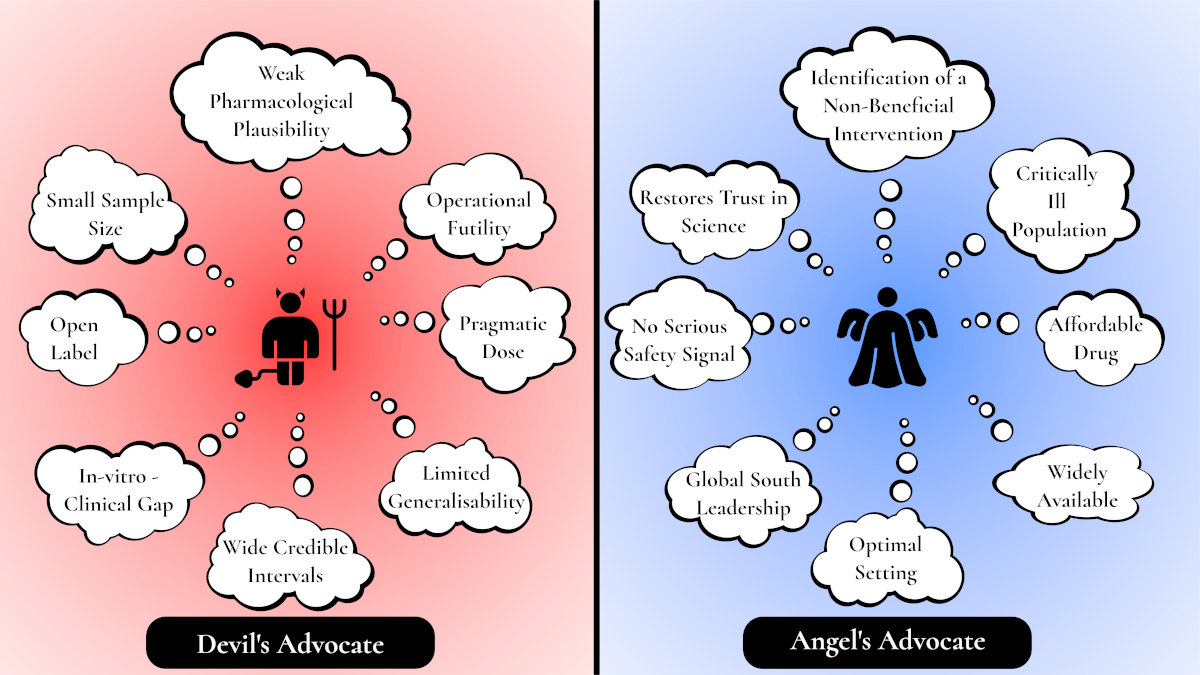
Figure 3. Devil's and Angel's Advocates

Devil’s advocate

The trial has limitations, and they should not be hidden. It was small. It was open-label. It stopped for operational futility rather than after crossing a formal statistical trigger. The dosing was pragmatic rather than aggressive. Almost all recruitment occurred in Pakistan and India. Only a small number of critically ill patients were invasively ventilated at baseline, despite the high mortality.5

Each of these points is fair. None rescues routine ivermectin use.

The dose critique is the most common. REMAP-CAP used 0.2 mg/kg once daily, up to a maximum of 24 mg, for up to five days.5 One can argue that higher dosing might have been more pharmacologically ambitious. But this argument must be weighed against the early pharmacokinetic concern that clinically achievable concentrations were unlikely to reproduce the in-vitro antiviral signal, and against subsequent outpatient trial evidence in which higher-dose and longer-duration ivermectin still did not improve sustained recovery.12,21 At some point, “wrong dose” becomes less persuasive than “wrong hypothesis”.

The sample-size critique is also valid. The credible intervals are wide. But imprecision cuts both ways. It means we should not claim metaphysical certainty that ivermectin can never help anyone in any COVID-19 context. It also means we should not manufacture enthusiasm from unstable point estimates. The best synthesis is that the REMAP-CAP result, when placed beside the broader randomised trial literature and guideline recommendations, provides no credible basis for routine use.15,22

The external-validity critique is more interesting. REMAP-CAP’s ivermectin population was mostly South Asian, with high mortality and relatively low IL-6 antagonist use.5 But that is not a weakness in the usual sense. It is part of the reason the trial is valuable. It tests the intervention in health systems where the question mattered, where affordability mattered, and where a low-cost therapy would have been most consequential had it worked.

A final critic might say that bloodletting is too harsh a metaphor. Perhaps. Ivermectin at the dose used in this trial was not a brutal eighteenth-century intervention. But the comparison is not about direct toxicity. It is about the structure of belief. In both stories, a therapy became compelling because it was plausible, active, endorsed, and emotionally satisfying. In both, the question that mattered was not whether the treatment could be explained, but whether patients were better off.


Angel’s advocate

The best defence of REMAP-CAP’s ivermectin trial is not that it was perfect. It is that it was necessary.

It asked a question that social practice had already forced onto medicine. It tested a low-cost therapy in settings where low-cost therapies matter. It used a platform designed for pandemic uncertainty. It enrolled critically and noncritically ill patients. It used an outcome that captures survival and the burden of organ support. It reported uncertainty rather than converting a stopped trial into a slogan.5,23

Most importantly, it contributes to the scientific closure of a treatment claim that had become resistant to ordinary correction. In medicine, stopping is often harder than starting. Starting has urgency, novelty, hope, and visible action. Stopping has disappointment, confrontation, and the burden of telling patients that what was promised was not real. Trials like this make stopping easier because they shift the conversation from personality to probability.

This is exactly what Louis’ numerical method began to do for bloodletting. It did not merely disprove a practice; it changed the terms of argument. The physician could no longer appeal only to theory, tradition, eminence or memorable recoveries. He had to face the denominator.


What do we do on Monday?

For hospitalised patients with COVID-19, including critically ill patients, ivermectin should not be used routinely outside a properly approved clinical trial. That position is not based on disdain for cheap therapies, nor on indifference to global inequity. It is based on the absence of persuasive benefit in REMAP-CAP, the negative direction of the wider randomised trial literature, pharmacological concerns that preceded the clinical trials, and current regulatory and guideline positions.5,15,14,22

Hospitals should treat this as an active de-implementation task. That means removing ivermectin from COVID-19 order sets, aligning local guidance with current evidence, supporting clinicians in difficult conversations with patients and families, and resisting the re-entry of non-beneficial therapies through “just in case” prescribing. The hardest low-value treatments to remove are often those that feel benign. But benign-feeling medicine can still be harmful when it consumes attention, confuses priorities, or displaces effective care.

Historically, medicine did not advance simply by inventing antibiotics, anaesthesia, antisepsis and intensive care. It also advanced by abandoning purging, blistering, indiscriminate bleeding, and other rituals of therapeutic certainty. The modern equivalent is not always dramatic. It may be an order set quietly removed, a guideline changed, a family conversation conducted honestly, or a clinician choosing not to prescribe a treatment that offers reassurance without benefit.

The next pandemic will generate the same pattern again. A biologically plausible therapy will appear. It will be cheap, available, and emotionally attractive. Early uncontrolled data will be amplified. Public figures will become certain before trialists are confident. The correct response is not cynicism. It is speed, discipline, and humility: test the claim rapidly, interpret it honestly, implement benefit, and de-implement non-benefit.


Conclusion

REMAP-CAP’s ivermectin trial should not be read as a culture-war footnote. It should be read as a case study in the science of stopping. The trial addressed a therapy whose evidential foundations were weak but whose social momentum was strong. It found no persuasive improvement in organ support-free days or survival among critically or noncritically ill hospitalised patients with COVID-19. It did not mathematically close every possible door, but it closed the door that matters most for practice: routine hospital use.

Bloodletting teaches that medicine can be most dangerous when it mistakes activity for efficacy. Ivermectin teaches that the same error can recur in modern form, accelerated by media, politics, desperation and the understandable desire for cheap solutions. REMAP-CAP teaches the corrective discipline: count the patients, compare the outcomes, and be prepared to stop.

That is not a small contribution. In critical care, doing less can be lifesaving when what we stop doing is ineffective, distracting, or harmful. Some trials discover treatments. Others help medicine recover from treatments that should never have been adopted. Bloodletting did not disappear because medicine became less active, but because it became more accountable to outcomes than to theory, ritual, eminence, or hope. REMAP-CAP’s ivermectin trial belongs to that same long and uncomfortable tradition: the moment when counting finally overtakes conviction, and when a treatment sustained by plausibility and belief is finally bled dry to the last drop.

References

1. George Washington’s Mount Vernon. The Death of George Washington. Accessed 10 May 2026.

2. Vadakan VV. The Asphyxiating and Exsanguinating Death of President George Washington. The Permanente Journal. 2004;8:76–79.

3. Greenstone G. The history of bloodletting. British Columbia Medical Journal. 2010;52:12–14.

4. Morabia A. Pierre-Charles-Alexandre Louis and the evaluation of bloodletting. Journal of the Royal Society of Medicine. 2006;99:158–160.

5. Hashmi M, Haniffa R, Jayakumar D, Beane A, Lorenzi E, Berry LR, et al; REMAP-CAP Investigators. Ivermectin for Critically and Noncritically Ill Hospitalized Patients With COVID-19: Randomized, Embedded, Multifactorial Adaptive Platform Trial for Community-Acquired Pneumonia (REMAP-CAP). Critical Care Medicine. 2026;54:XX–XX.

6. REMAP-CAP Investigators. Supplementary Appendix to: Ivermectin for Critically and Non-critically Ill Hospitalized Patients With COVID-19: REMAP-CAP Randomized Controlled Trial. 2026.

7. World Health Organization. Coronavirus disease (COVID-19): fact sheet. Updated 27 November 2025. Accessed 10 May 2026.

8. Lind JN, Lovegrove MC, Geller AI, Uyeki TM, Datta SD, Budnitz DS. Increase in Outpatient Ivermectin Dispensing in the US During the COVID-19 Pandemic: A Cross-Sectional Analysis. Journal of General Internal Medicine. 2021;36:2909–2911.

9. Centers for Disease Control and Prevention. Rapid Increase in Ivermectin Prescriptions and Reports of Severe Illness Associated With Use of Products Containing Ivermectin to Prevent or Treat COVID-19. CDC Health Alert Network. August 26, 2021. Accessed 10 May 2026.

10. Perlis RH, Lunz Trujillo K, Green J, Safarpour A, Druckman JN, Santillana M, et al. Misinformation, Trust, and Use of Ivermectin and Hydroxychloroquine for COVID-19. JAMA Health Forum. 2023;4:e233257.

11. Caly L, Druce JD, Catton MG, Jans DA, Wagstaff KM. The FDA-approved drug ivermectin inhibits the replication of SARS-CoV-2 in vitro. Antiviral Research. 2020;178:104787.

12. Schmith VD, Zhou JJ, Lohmer LRL. The Approved Dose of Ivermectin Alone is not the Ideal Dose for the Treatment of COVID-19. Clinical Pharmacology & Therapeutics. 2020;108:762–765.

13. Merck. Merck Statement on Ivermectin Use During the COVID-19 Pandemic. February 4, 2021. Accessed 10 May 2026.

14. U.S. Food and Drug Administration. Ivermectin and COVID-19. Updated April 5, 2024. Accessed 10 May 2026.

15. Popp M, Reis S, Schiesser S, Hausinger RI, Stegemann M, Metzendorf MI, et al. Ivermectin for preventing and treating COVID-19. Cochrane Database of Systematic Reviews. 2022;(6):CD015017.

16. López-Medina E, López P, Hurtado IC, Dávalos DM, Ramirez O, Martínez E, et al. Effect of Ivermectin on Time to Resolution of Symptoms Among Adults With Mild COVID-19: A Randomized Clinical Trial. JAMA. 2021;325:1426–1435.

17. Reis G, Silva EASM, Silva DCM, Thabane L, Milagres AC, Ferreira TS, et al; TOGETHER Investigators. Effect of Early Treatment with Ivermectin among Patients with Covid-19. New England Journal of Medicine. 2022;386:1721–1731.

18. Bramante CT, Huling JD, Tignanelli CJ, Buse JB, Liebovitz DM, Nicklas JM, et al. Randomized Trial of Metformin, Ivermectin, and Fluvoxamine for Covid-19. New England Journal of Medicine. 2022;387:599–610.

19. Lim SCL, Hor CP, Tay KH, Mat Jelani A, Tan WH, Ker HB, et al; I-TECH Study Group. Efficacy of Ivermectin Treatment on Disease Progression Among Adults With Mild to Moderate COVID-19 and Comorbidities: The I-TECH Randomized Clinical Trial. JAMA Internal Medicine. 2022;182:426–435.

20. Naggie S, Boulware DR, Lindsell CJ, Stewart TG, Gentile N, Collins S, et al; ACTIV-6 Study Group and Investigators. Effect of Ivermectin vs Placebo on Time to Sustained Recovery in Outpatients With Mild to Moderate COVID-19: A Randomized Clinical Trial. JAMA. 2022;328:1595–1603.

21. Naggie S, Boulware DR, Lindsell CJ, Stewart TG, Gentile N, Collins S, et al; ACTIV-6 Study Group and Investigators. Effect of Higher-Dose Ivermectin for 6 Days vs Placebo on Time to Sustained Recovery in Outpatients With COVID-19: A Randomized Clinical Trial. JAMA. 2023;329:888–897.

22. World Health Organization. Therapeutics and COVID-19: living guideline, August 2025. Geneva: World Health Organization; 2025. Accessed 10 May 2026.

23. Angus DC, Berry S, Lewis RJ, Al-Beidh F, Arabi Y, van Bentum-Puijk W, et al. The REMAP-CAP (Randomized Embedded Multifactorial Adaptive Platform for Community-acquired Pneumonia) Study: Rationale and Design. Annals of the American Thoracic Society. 2020;17:879–891.

24. Usher AD. The global COVID-19 treatment divide. The Lancet. 2022;399:779–782.

25. RECOVERY Collaborative Group. Dexamethasone in Hospitalized Patients with Covid-19. New England Journal of Medicine. 2021;384:693–704.

26. REMAP-CAP Investigators. Interleukin-6 Receptor Antagonists in Critically Ill Patients with Covid-19. New England Journal of Medicine. 2021;384:1491–1502.

27. Arabi YM, Gordon AC, Derde LPG, Nichol AD, Murthy S, Beidh FA, et al; REMAP-CAP Investigators. Lopinavir-ritonavir and hydroxychloroquine for critically ill patients with COVID-19: REMAP-CAP randomized controlled trial. Intensive Care Medicine. 2021;47:867–886.

28. Ganguli I, Thakore N, Rosenthal MB, Korenstein D. Longitudinal Content Analysis of the Characteristics and Expected Impact of Low-Value Services Identified in US Choosing Wisely Recommendations. JAMA Internal Medicine. 2022;182:127–133.

29. Niven DJ, Mrklas KJ, Holodinsky JK, Straus SE, Hemmelgarn BR, Jeffs LP, et al. Towards understanding the de-adoption of low-value clinical practices: a scoping review. BMC Medicine. 2015;13:255.

30. Prasad V, Ioannidis JPA. Evidence-based de-implementation for contradicted, unproven, and aspiring healthcare practices. Implementation Science. 2014;9:1.

31. Chua KP, Conti RM, Becker NV. US Insurer Spending on Ivermectin Prescriptions for COVID-19. JAMA. 2022;327:584–587.


  • Posted May 13th, 2026
  • This blog was written with the assistance of AI